
George Alogoskoufis
This post was first published in Substack.com
_________________________________________________________
Christine Lagarde’s presidency of the European Central Bank has been shaped by shocks that were difficult to predict and harder to manage: the Covid-19 pandemic, Russia’s invasion of Ukraine, a surge in energy prices and the return of inflation to levels not seen in the euro area for decades. Mario Draghi, her predecessor, faced a different threat. During the sovereign-debt crisis, investors doubted whether the euro itself would survive.
The contrast is not simply between two leaders or two styles. Each ECB president inherited a distinct economic and political landscape, and monetary policy was decided by the ECB’s Governing Council, not by its president alone. Still, their presidencies offer a revealing comparison of how the ECB’s role has changed—from defending the integrity of the currency union to navigating extraordinary economic shocks while pursuing price stability.
Draghi: preserving the euro
Mario Draghi took office in November 2011, when the euro-area crisis threatened to become an existential crisis for the single currency. Financial markets were fragmenting along national lines. Borrowing costs for several governments rose sharply, and fears of default or euro exit weakened the transmission of ECB policy across member states.
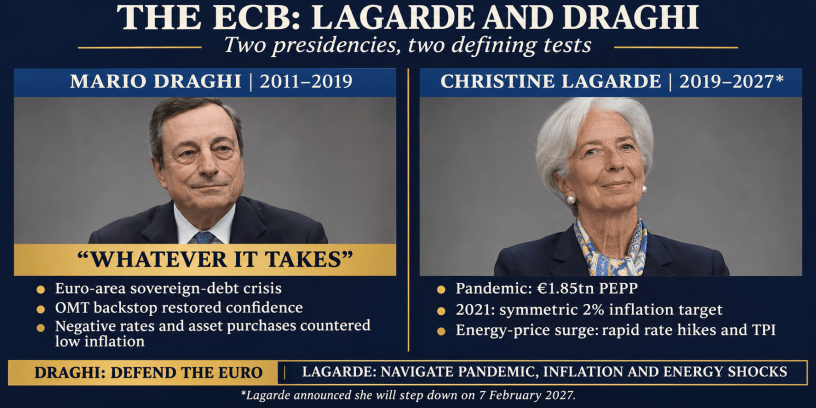
Draghi’s defining intervention came in July 2012, when he said that the ECB was ready to do “whatever it takes” within its mandate to preserve the euro. The words were followed by a proposed backstop: Outright Monetary Transactions, or OMT. The programme allowed for potentially substantial purchases of a country’s government bonds on secondary markets, subject to conditions and an agreed economic-adjustment programme. It was never activated, but its announcement helped calm markets and reduce the risk that countries would be forced out of the euro by self-reinforcing panic.
OMT was more than a new instrument. It expressed a central principle of the euro’s monetary union: the ECB could act against market fragmentation when it threatened the transmission of a common monetary policy. But the programme also exposed the limits of monetary action. It could buy time and contain financial panic; it could not by itself resolve the euro area’s underlying institutional weaknesses or replace decisions by national governments.
Draghi’s ECB also used increasingly unconventional monetary tools to address persistently weak inflation and the aftermath of the crisis. It cut interest rates to very low levels, introduced negative rates on bank deposits and launched large-scale asset purchases. These policies were controversial, particularly in countries concerned about the effects on savers, banks and fiscal incentives. Yet they reflected a real problem: inflation remained too low, while the conventional scope for rate cuts was limited.
Lagarde: pandemic support, then an inflation reversal
Lagarde became ECB president on 1 November 2019, just months before the pandemic transformed the global economic outlook. The initial shock created a risk that financial stress and rising government borrowing costs would once again divide the euro area. The ECB’s Pandemic Emergency Purchase Programme (PEPP), launched in March 2020, gave the Eurosystem flexibility to buy public and private securities during the crisis. Its envelope eventually reached €1.85 trillion. The programme helped protect financing conditions and monetary-policy transmission while governments supported households and businesses through the shutdowns.
The scale and flexibility of the response marked a major institutional achievement. The pandemic was not a sovereign-debt crisis, but it revived the problem of unequal financial pressures across countries. PEPP allowed the ECB to respond to that risk without making a repeat of OMT the centrepiece of its action.
In July 2021, the ECB completed a strategy review and adopted a symmetric 2% inflation target over the medium term. Under the symmetric formulation, inflation below target is as undesirable as inflation above it. The review also addressed the low-inflation environment that had shaped policy during much of Draghi’s presidency, updated the ECB’s communication and set out how climate-related risks could be considered within its mandate. The ECB reaffirmed the 2% target in its 2025 assessment.
The setting changed dramatically soon afterwards. Inflation rose as demand recovered, supply chains remained disrupted and energy prices surged. Russia’s invasion of Ukraine intensified the energy shock. Euro-area annual inflation reached 10.6% in October 2022. Critics argued that the ECB had been slow to recognise the persistence of inflation and that its earlier communication had placed too much weight on the temporary nature of price pressures. The ECB began raising rates in July 2022, then tightened rapidly. The Governing Council also approved the Transmission Protection Instrument (TPI), designed to address disorderly market movements that could impair monetary-policy transmission across the euro area.
This episode presents the hardest judgement on Lagarde’s monetary-policy record. The inflation surge was driven substantially by supply and energy shocks, which interest-rate increases could not directly reverse. But once price increases broadened and proved more persistent, the ECB had to tighten forcefully. That tightening helped bring inflation down, though the fall also reflected easing energy pressures and the unwinding of supply disruptions. Monetary policy’s effects were uneven: higher rates restrained demand but increased borrowing costs for households, firms and governments.
By late 2026, the challenge had shifted again. The ECB had cut rates as inflation receded, then raised them when energy prices climbed anew. At its 29 October meeting, the Governing Council held the deposit-facility rate at 2.50%, while warning that rising energy prices presented upside risks to inflation and downside risks to growth. It retained a data-dependent, meeting-by-meeting approach. The ECB’s assessment reported headline inflation at 3.8% in September, driven chiefly by energy, while measures of underlying inflation had remained broadly stable.
Two presidencies, two tests
Draghi’s legacy rests above all on preventing a financial panic from breaking up the euro. His “whatever it takes” commitment and the OMT framework showed how a central bank could defend the currency union’s integrity, even while political agreement on deeper fiscal and institutional reforms remained elusive. His tenure also expanded the ECB’s policy toolkit in response to low inflation.
Lagarde’s record is more varied because the ECB faced several abrupt changes in direction. She oversaw the pandemic response, the adoption of a clearer symmetric inflation target, the sharp tightening needed to counter the inflation surge, and a later return to rate cuts as inflation fell. The TPI extended the ECB’s capacity to protect policy transmission. Her presidency also gave greater prominence to communication, climate-related financial risks and the implications of structural change for inflation.
The comparison should not obscure continuity. Both presidents used new or expanded instruments when the existing framework proved inadequate. Both faced criticism: Draghi for stretching the ECB’s mandate, Lagarde for the timing and communication of the response to rising inflation. And both operated within an incomplete monetary union, where the ECB can stabilise markets but cannot substitute for common fiscal capacity or national economic policies.
Lagarde’s departure announcement adds an unexpected coda. Although appointed for an eight-year term ending in 2027, she announced on 29 October 2026 that she would step down on 7 February 2027. Her successor will inherit a euro area again exposed to an energy shock, with inflation above target and growth vulnerable.
Draghi’s central question was whether the euro could survive. Lagarde’s has been how the ECB should respond as the sources and direction of inflation change—without losing sight of the unequal effects of monetary policy across its member states. Draghi’s achievement was to make the ECB a credible guardian of the currency union in a moment of acute danger. Lagarde’s will be judged by whether the institution can combine crisis flexibility with the discipline needed to anchor inflation expectations. In both cases, the presidency mattered most when the ECB had to translate its mandate into action under pressure.

