
George Alogoskoufis
This article was first published in Substack.com.
______________________________________________________
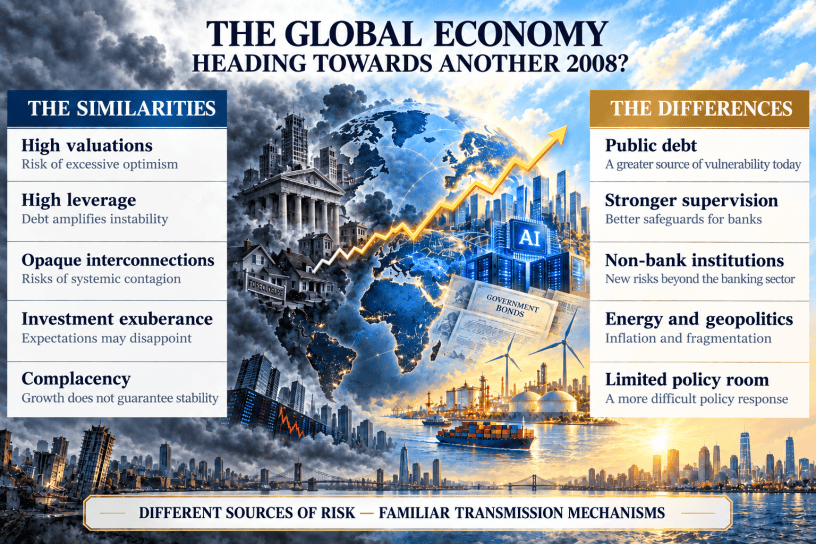
The current international economic situation bears some troubling similarities to the period preceding the financial crisis of 2008–2009. High asset valuations, accumulated debt, complex financial interconnections and optimism about the potential of AI technology coexist with significant economic vulnerabilities. Yet the differences are equally substantial. The possible sources of a new crisis, the international environment and the scope for the response of economic policy have changed. The question is not simply whether 2008 will happen again, but whether we have understood the mechanisms that turn economic shocks and imbalances into systemic instability.
Before the previous crisis, the global economy appeared to have entered an era of lasting prosperity. Growth was strong, international trade was expanding and inflation in advanced economies remained relatively subdued. The so-called “Great Moderation” had strengthened the belief that better monetary policy and financial innovation were reducing the risk of major fluctuations. In reality, this apparent stability encouraged increasingly risky behaviour.
At the centre stood the American housing market. Credit expansion, mortgage lending to borrowers with poor creditworthiness and the securitisation of those loans created a web of financial claims whose underlying risks were difficult to assess. Distributing loans among many investors was thought to enhance safety. When house prices fell, however, it became clear that the risks were closely correlated. Uncertainty about losses undermined confidence, disrupted funding and transmitted the crisis to the real economy.
The first similarity with today is the tendency of markets to turn a plausible economic expectation into risky bets. Before 2008, the prevailing assumption was that house prices were unlikely to fall nationwide. Today, artificial intelligence is fuelling expectations of substantial increases in productivity and corporate profits. Its potential is considerable, but neither the timing of these gains nor the distribution of their benefits is assured. A technological revolution can transform the economy while also generating overvalued investments.
The danger increases when large investment expenditures rest on optimistic revenue forecasts and, partly, on borrowing. If anticipated profits are delayed, investment cuts, falling valuations and losses for lenders may follow. The Bank for International Settlements has highlighted the risks arising from the concentration of investment in artificial intelligence and the interdependencies surrounding it. This does not establish that an AI bubble comparable to the housing bubble exists. It does suggest, however, that technological optimism requires rigorous scrutiny.
The second similarity concerns leverage and opacity. Before 2008, risks were often concealed in complex products and activities outside bank balance sheets. Today, investment funds, private credit institutions and other non-bank financial intermediaries play a larger role. Their expansion broadens the sources of finance, but also creates connections that are not always transparent. Particularly in government bond markets, leveraged strategies dependent on continuous funding can amplify disruption through forced asset sales.
A third similarity is that the resilience of the real economy can create a misleading sense of security. Growth, employment and corporate profits do not fully reveal the vulnerability of the financial system. Balance sheets can deteriorate fast while economic activity continues to expand. The critical turning point comes when investors start simultaneously to question the value of collateral and their counterparties’ ability to meet their obligations. Attempts to reduce risk that are prudent for individual institutions can then destabilise the system as a whole.
The most important difference lies in where debt vulnerabilities are concentrated. In 2008, the crisis originated primarily in private borrowing and banks’ exposure to the mortgage market. Today, high public debt is a central element of international economic vulnerability. Rising borrowing costs gradually weigh on government budgets as older debt is refinanced. Meanwhile, spending needs for defence, infrastructure, the energy transition and social protection intensify fiscal pressures. Because government bonds are widely used as collateral, disruption in these markets can affect the entire financial system.
A second difference is institutional preparedness. Reforms following 2008 strengthened banking supervision and established financial stability as a central economic policy priority. Authorities now have the experience of the previous crisis and the interventions it required. This is a substantial advantage. It does not, however, guarantee that new risks will be identified promptly, particularly when they emerge in non-bank institutions and markets different from those at the centre of the previous collapse.
The macroeconomic and geopolitical environment is also different. Today, energy disruptions, military conflicts and trade restrictions affect production and prices simultaneously. International organizations project global growth in the region of 2.9% in 2026 and 3.0% in 2027, while highlighting persistent inflationary pressures and uncertainty. This picture combines economic resilience with weak momentum and successive supply shocks. It differs both from the optimism preceding 2008 and from the collapse in demand that followed the outbreak of the previous crisis.
These conditions create more difficult policy dilemmas. A new financial disturbance would require an immediate provision of liquidity, but persistent inflation would constrain the scope for broad monetary easing. Support for market functioning would need to be carefully distinguished from measures intended to stimulate aggregate demand. Similarly, high public debt makes large fiscal interventions more expensive. Geoeconomic fragmentation further complicates international coordination, precisely when cross-border financial connections make international cooperation essential.
There are insufficient grounds to regard a repeat of 2008 as likely. There are, however, compelling reasons to avoid complacency. Priorities should include identifying leverage early, increasing transparency across financial interconnections and rebuilding fiscal room for manoeuvre. The lesson of the previous crisis is that stability requires policy vigilance. The next crisis, if it occurs, may begin in a different market, but spread through the same familiar mechanisms: loss of confidence, withdrawal of funding and forced deleveraging.

