
George Alogoskoufis
_______________________________________
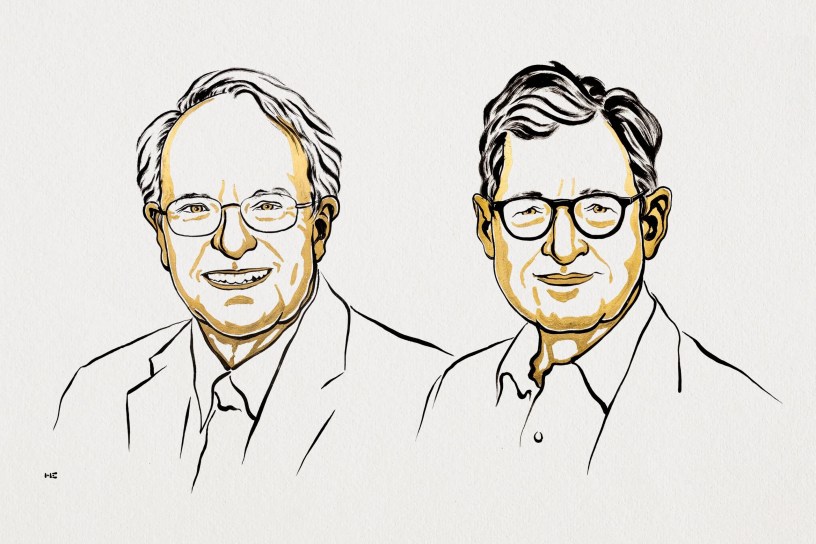
The Royal Swedish Academy of Sciences has decided to award the Sveriges Riksbank Prize in Economic Sciences in Memory of Alfred Nobel 2026 to Robert E. Hall, Stanford University, CA, USA and Michael Woodford, Columbia University, New York, USA, “for microeconomic foundations of macroeconomic stabilisation”.
This is a long overdue award. Along with many others, this year’s laureates in the economic sciences have developed ‘new Keynesian’ macroeconomic models that have significantly improved our ability to implement effective stabilisation policy. On the basis of these models, well-timed fiscal and monetary policy measures can reduce the economy’s peaks and troughs.
In the scientific background paper to the Sveriges Riksbank Prize in Economic Sciences in Memory of Alfred Nobel 2026, the Committee notes among others that.
“This year’s prize recognizes two researchers—Robert E. Hall and Michael Woodford—for their key contributions toward a new macroeconomic framework for monetary and fiscal stabilization policy. In a seminal article from 1978, Hall showed that a theory of consumption smoothing—the idea that consumers prefer consumption to be stable over time—worked surprisingly well for understanding the movements of aggregate consumption in the data. The theory had elements in common with Keynesian consumption theory but was, at its roots, fundamentally different in that it relied on fully rational, forward-looking consumer behavior rather than mechanical rules-of thumb. The theory in particular implied that consumption was not as easily manipulable by government policy as was previously thought, potentially thus limiting the effects of stabilization policy.
Through a series of subsequent papers, built on Hall’s consumption framework as well as other important developments in macroeconomic theory during the 1970s and 1980s, Michael Woodford arose as the key architect behind the so-called New Keynesian model: a full macroeconomic stabilization framework that has become the main tool for policymakers today. In his 2003 monograph, Woodford summarizes as well as further develops the general setting. The original theory was chiefly aimed as a foundation for monetary policy analysis but subsequently also became the main tool for the analysis of fiscal policy. This model features departures from perfect competition, with firms charging markups over marginal cost, as well as sticky prices and wages preventing the efficient use of resources. Despite allowing consumers and firms in the model to adapt their behavior to changes in government policy, it shows how appropriately used fiscal and monetary policy can improve welfare by stabilizing the economy in the face of disturbances.
As the core model had been around for about a decade when the Great Recession suddenly hit our economies in 2008, it turned out to be of great practical use, as it helped steer the economy onto the right path. This help came not only because the new framework helped us analyze the situation, but also by suggesting new policy instruments.
The specific research contributions underlying the prize were put together independently and with quite some time in between. The final macroeconomic stabilization framework also builds on contributions of many different researchers, including several Nobel Laureates in the Economic Sciences.”
It has to be noted that many other researchers have made pivotal contributions to the development of ‘new Keynesian’ macroeconomics, including, the late Stanley Fischer, John Taylor, Olivier Blanchard, George Akerlof, Janet Yellen, Joseph Stiglitz, Gregory Mankiw, David Romer, Laurence Ball, Jordi Gali and many others. Their contributions can be found in the two volumes published by MIT Press more than 35 years ago:
Mankiw, N. G. and Romer, D. (eds), (1991), New Keynesian Economics, Vol. 1: Imperfect Competition and Sticky Prices, Vol. 2: Coordination Failures and Real Rigidities, Cambridge MA, MIT Press.
These contributions have generated a huge literature, including my own research, and made their way in advanced macroeconomics textbooks, such as,
Romer, D. (2001), Advanced Macroeconomics, (Fifth Edition, 2019), New York, NY, McGraw-Hill
Alogoskoufis, G. (2019), Dynamic Macroeconomics, Cambridge MA, MIT Press.
It was time that the Royal Swedish Academy of Sciences recognised this important body of research in the persons of Robert Hall and Michael Woodford.
________________________________________________
Link to the Announcement of the Royal Swedish Academy of Sciences

