
George Alogoskoufis (with help from ChatGPT)
Jensen Huang’s return to the helm of Nvidia brought a paradox into focus. The company has become a major supplier of computing power to the global economy, yet market confidence in its strategy remains closely tied to its co-founder. On November 23, 2026, Nvidia announced that its board had voted unanimously to reinstate Huang as chief executive officer, company president and board member. Colette Kress, who had taken over as interim CEO after his resignation was announced on November 12, remained chief financial officer. Harvey Jones stayed on as chair of the board.
Nvidia’s shares rose 31.5% on the day of the announcement, recovering some of the losses that followed Huang’s departure. The reaction shows how much investors value continuity at the top. Nvidia’s prospects, however, will depend chiefly on whether it can preserve its advantage as artificial intelligence moves from training impressive models to putting them to everyday commercial use.
How Nvidia Became a Key Supplier to the AI Industry
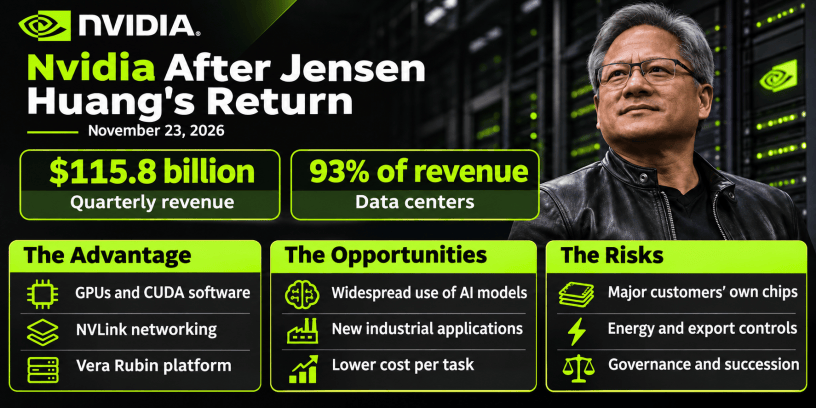
Nvidia started out making graphics processing units, or GPUs. Built to perform many similar operations at once, they turned out to be well suited to the matrix multiplications on which neural networks rely. With large models, performance also depends on how quickly data reach the processors and how efficiently the processors communicate with one another. Nvidia combines GPUs, high-bandwidth memory and interconnects such as NVLink. With its Vera Rubin platform, whose initial shipments had already been announced, the company now designs and sells an integrated computing system.
Its most durable advantage is probably CUDA, the platform used to program its processors. Software libraries, tools and engineering expertise have grown up around CUDA, helping teams get up to speed quickly with Nvidia hardware. Switching to a competing processor can require adapting code, rerunning performance tests and retraining staff. Customers therefore weigh the full cost of switching and the time it will take to put an application into production. This allows Nvidia to capture a larger share of the value created jointly by hardware, software and networking.
The scale of that advantage is visible in the company’s accounts. In the quarter ended October 25, 2026, revenue reached $115.8 billion, up 103% from a year earlier. Data centres generated $107.6 billion, about 93% of the total, while the gross margin stood at 74.8%. The business that explains Nvidia’s rapid growth also accounts for its exposure to the AI investment cycle.
The Opportunities
The biggest opportunity lies in running models once they have been trained, a process known as inference. Every response, document analysis or complex task requires computing power. An application that searches for information, uses tools and checks its own work may call the model several times to handle a single request. If these uses become part of everyday business operations, demand will increasingly come from the ongoing use of models. Nvidia has already designed Vera Rubin to handle both training and these kinds of applications.
There is also room to broaden Nvidia’s customer base. Industrial companies that use simulations, research centres and public bodies that want to retain control of their data can support demand beyond the major cloud providers. Huang’s return helps maintain continuity with customers and suppliers during the transition to the next generation of systems. Commercial success will depend on whether those systems bring down the cost per task enough to make more applications viable.
The Risks
Nvidia’s largest customers also have the strongest incentive to reduce their dependence on it. Three direct customers accounted for 36% of quarterly revenue. A major cloud provider can buy Nvidia GPUs to train new models and use its own accelerators for repetitive tasks at scale. If it shifts some of its computing demand to its own chips, it can strengthen its bargaining power. Nvidia’s margins could therefore come under pressure even in a rapidly growing market.
The return on customers’ investments is a second risk. If revenue from AI services falls short of what customers are spending on infrastructure, orders could slow even as use of the technology continues to grow. There are physical constraints as well. The availability of electricity and the time it takes to connect to the grid determine when a data centre can begin operating. Meanwhile, US export controls on shipments to China affect Nvidia’s access to an important market and increase the incentive to develop domestic alternatives there.
Finally, Huang’s reinstatement leaves questions about corporate governance. The board said it had considered input from senior US officials and concluded that his return posed no national security risk. According to Reuters, the board’s reversal while its internal investigation remained unfinished raised doubts about its independence. For a company whose decisions affect customers and governments around the world, credible board oversight and a succession plan have economic consequences.
Huang’s return gives Nvidia continuity of leadership at a time of technological change. In the favourable scenario, the spread of AI lifts demand for integrated systems fast enough to outweigh the price pressure from competition. In the less favourable scenario, AI use keeps expanding, but customers that design their own processors capture a larger share of the value. Nvidia’s fortunes will depend on how often customers find that its combination of processors, software and networking still justifies the price.

