
George Alogoskoufis
For much of the post-war era, Europe represented one of the great economic success stories of modern history. Through economic integration, political stability and the gradual construction of a common market, the continent transformed itself from a region devastated by war into one of the wealthiest and most prosperous parts of the world. The European model combined economic efficiency with social cohesion, delivering high living standards, broad access to public services and relatively low levels of inequality.
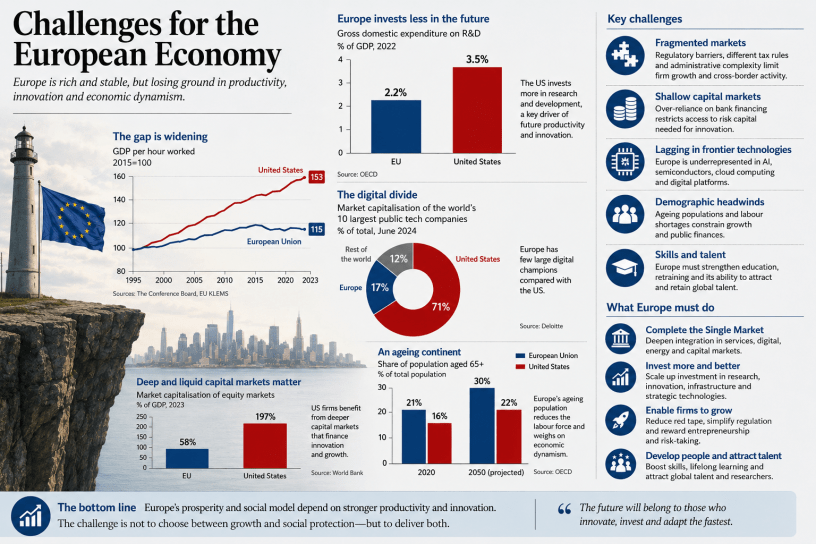
Today, however, Europe faces a growing challenge. While it remains rich and stable, it is becoming increasingly apparent that the European economy is losing ground to the United States in productivity growth, technological innovation and economic dynamism. The issue is not one of imminent decline. Rather, it is whether Europe can sustain its prosperity in a world where economic power is increasingly determined by technology, innovation and the ability to adapt rapidly to change.
The contrast with America is striking. Since the mid-1990s, labour productivity in the United States has grown significantly faster than in the European Union. The gap has widened further during the digital age. America has produced most of the world’s leading technology firms, dominates global venture capital markets and has become the epicentre of innovation in artificial intelligence, cloud computing and advanced software. Europe, despite its many strengths, has struggled to generate companies of similar scale and global influence.
This divergence is particularly significant because productivity growth ultimately determines living standards. A country or region can prosper in the long run only if it becomes more efficient at producing goods and services. Productivity is what allows wages to rise, public services to improve and social protection systems to remain sustainable. Europe’s productivity slowdown therefore represents a strategic challenge rather than a narrow economic concern.
Part of the problem lies in the very structure of the European economy. The European Union has created an impressive single market for goods, but the integration of services, digital activities and capital markets remains incomplete. Europe is often described as a continental economy, yet in many respects it still operates as a collection of national markets. Regulatory fragmentation, differing tax systems and administrative barriers continue to limit the ability of firms to expand across borders.
An innovative American company can scale rapidly within a single market of more than 330 million consumers. A European company seeking to achieve similar scale frequently encounters regulatory and institutional obstacles as it moves from one member state to another. This fragmentation reduces economies of scale and makes it harder for European firms to compete globally.
A second weakness is Europe’s financial architecture. European businesses continue to rely heavily on bank financing, whereas American firms benefit from deep and sophisticated capital markets. This distinction matters because innovation often requires large amounts of risk capital. Venture-capital investors are willing to finance projects with uncertain outcomes in exchange for potentially large rewards. Banks, by contrast, are generally better suited to funding established businesses with predictable cash flows.
As a result, many promising European technology firms either struggle to secure financing or eventually relocate to the United States. Europe possesses world-class universities and highly skilled researchers, but it frequently fails to transform scientific excellence into commercial success.
Technology is another area where Europe faces increasing competitive pressure. The continent remains a global leader in several advanced manufacturing industries, including pharmaceuticals, aerospace and industrial machinery. Yet the commanding heights of the digital economy are largely occupied by American firms. The same pattern is emerging in artificial intelligence, where the United States enjoys advantages in data, computing infrastructure, venture capital and entrepreneurial ecosystems.
The danger is not merely that Europe will import more technology from abroad. The deeper concern is that future productivity gains will increasingly originate in sectors where Europe is underrepresented. If the technologies driving growth are developed elsewhere, Europe risks becoming a consumer rather than a producer of innovation.
Demography adds another layer of complexity. Most European countries face ageing populations and low birth rates. A shrinking workforce places pressure on public finances and reduces economic dynamism. Meanwhile, the global competition for talent is intensifying. The United States continues to attract skilled migrants, entrepreneurs and researchers from around the world. Europe must find ways to remain equally attractive if it wishes to sustain its innovative capacity.
None of this implies that Europe should abandon its social model. Indeed, many of Europe’s strengths stem precisely from its commitment to social cohesion, public services and economic stability. The challenge is to reconcile these strengths with greater dynamism and adaptability.
The policy agenda is increasingly clear. Europe needs deeper capital markets, greater integration of services and digital industries, stronger incentives for innovation and a regulatory environment that allows successful firms to grow. It must invest more aggressively in research, advanced technologies and human capital. Above all, it must complete the unfinished project of economic integration.
The debate is often framed as one between efficiency and social protection. That is a false choice. Europe’s social model ultimately depends on economic growth and rising productivity. Without them, the fiscal and political foundations of the model will gradually weaken.
The central question for Europe is therefore not whether it can remain prosperous. It can. The question is whether it can remain innovative, competitive and strategically relevant in a world increasingly shaped by technological leadership. The answer will determine not only Europe’s economic future but also its role in the global order of the twenty-first century.

