
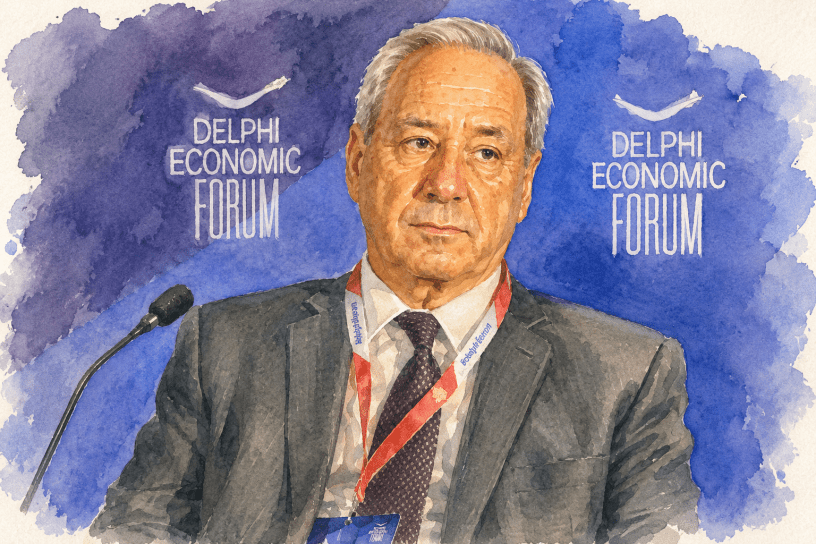
George Alogoskoufis
This article is based on the author’s remarks at the Delphi Economic Forum XI, on Friday, April 24, 2026.
____________________________________________________________________
The Greek economy is currently in a transitional phase. After a prolonged period of crisis and adjustment, significant improvements have been achieved in fiscal stability and the resilience of the financial system. However, behind macroeconomic stabilization and the return to positive growth rates, a deeper issue remains: the nature and characteristics of the country’s productive model. Without a substantive restructuring of this model, the prospects for sustainable growth and real convergence with Europe will remain limited.
The debate on Greece’s productive model is not new. Yet it has regained urgency in a context of international realignments, technological transformations, and geopolitical tensions. Greece is called upon to answer a critical question: can it transform the structure of its economy so as to become more productive, more outward-looking, and less vulnerable to crises?
Persistent Structural Weaknesses
The first, and perhaps most underestimated, weakness relates to demographics. Greece is among the fastest-aging societies in Europe. Low birth rates, combined with the emigration of young and highly educated workers during the previous decade, have led to a contraction of the working-age population. The implications are multifaceted: the economy’s potential output is constrained, social security systems are strained, and the dynamism of innovation is reduced. An economy with fewer young people tends to be less flexible and less future-oriented.
The second critical weakness is the low growth of productivity. Despite some improvements, labor productivity in Greece continues to lag significantly behind the European average. The problem is not only quantitative but also qualitative. The Greek business structure is characterized by a small average firm size, limited economies of scale, and low technological adoption. Moreover, the links between education, research, and production remain weak, with the result that knowledge is not easily translated into productive value.
A third structural deficiency concerns the low level of national savings and investment. Over recent decades, the Greek economy has relied more on consumption than on saving. This led to dependence on external financing, which proved particularly vulnerable during periods of crisis. Despite improvements in recent years, investment as a share of GDP remains low, especially in sectors with high value added and technological intensity. In addition, because of the extremely low level of household savings, any increase in investment results in widening current account deficits.
Finally, the structure of production shows an excessive concentration in non-tradable sectors. Construction, retail trade, and services primarily oriented toward domestic demand dominate economic activity. Although tourism is an exceptionally dynamic export sector, it is not sufficient on its own to offset the country’s limited export base. The result is an economy that does not fully exploit the opportunities offered by international markets.
The Need for a New Strategy
Overcoming these weaknesses cannot be achieved through fragmented interventions. What is required is a coherent and long-term strategy for transforming the productive model. At the core of this strategy should be three main pillars: increasing savings and investment, shifting toward tradable sectors, and strengthening technology and innovation.
The first pillar is the enhancement of savings and investment. Without adequate capital formation, sustainable growth cannot be achieved. The creation of a stable and predictable tax framework is a key prerequisite for strengthening confidence. At the same time, improving the functioning of the judicial system and reducing bureaucracy can lower the cost and uncertainty of investment. The effective utilization of European resources, particularly through the Recovery Fund, offers an opportunity to accelerate investment, provided that these resources are directed toward productive sectors.
The second pillar is the reorientation of economic activity toward tradable goods and services. Strengthening manufacturing, developing the agri-food sector with an emphasis on quality and export orientation, and capitalizing on the energy transition can create new sources of growth. Greece possesses comparative advantages in sectors such as shipping, logistics, and renewable energy, which can be more systematically leveraged.
The third and decisive pillar is investment in knowledge and technology. In an era in which productivity is increasingly driven by innovation, Greece cannot rely on traditional models of growth. Increasing expenditure on research and development, strengthening cooperation between universities and businesses, and supporting startups are critical priorities. Digital transformation, both in the private and public sectors, can act as a catalyst for productivity growth. In an economy where the population is declining, digital technologies can become the engine of growth through investments in capital-intensive rather than labor-intensive sectors.
The Challenge of Transition
The transition to a new productive model is not an easy undertaking. It requires time, consistency, and political will. It also entails a reallocation of resources and adjustments that may encounter resistance. However, the alternative—maintaining the existing model—carries the risk of stagnation and marginalization in a rapidly evolving international environment.
Greece today has a historic opportunity. Improvements in institutions, the strengthening of the credibility of economic policy, and access to significant European resources create the conditions for a meaningful transformation. The key question is whether these opportunities will be utilized in a way that permanently alters the structure of the economy.
Ultimately, the Greek productive model is not merely a technical issue of economic policy. It is a broader social and developmental challenge that concerns the country’s future. The choice between stagnation and dynamic adjustment will determine Greece’s position in the European and global economy in the decades ahead.
It is therefore essential that political parties, social partners, and the academic community work together and reach a consensus on the main directions of a new productive model for the country, as well as on the reforms required for its swift implementation.
© George Alogoskoufis
 Prof George Alogoskoufis