
George Alogoskoufis
Few markets reflect the pulse of the world economy as clearly as the market for crude oil. The evolution of oil prices over the past four decades illustrates how closely energy markets are intertwined with global economic cycles, geopolitical tensions, and technological change. The trajectory of Brent crude oil prices since the late 1980s tells a story not only about energy but about the broader dynamics of the world economy itself.
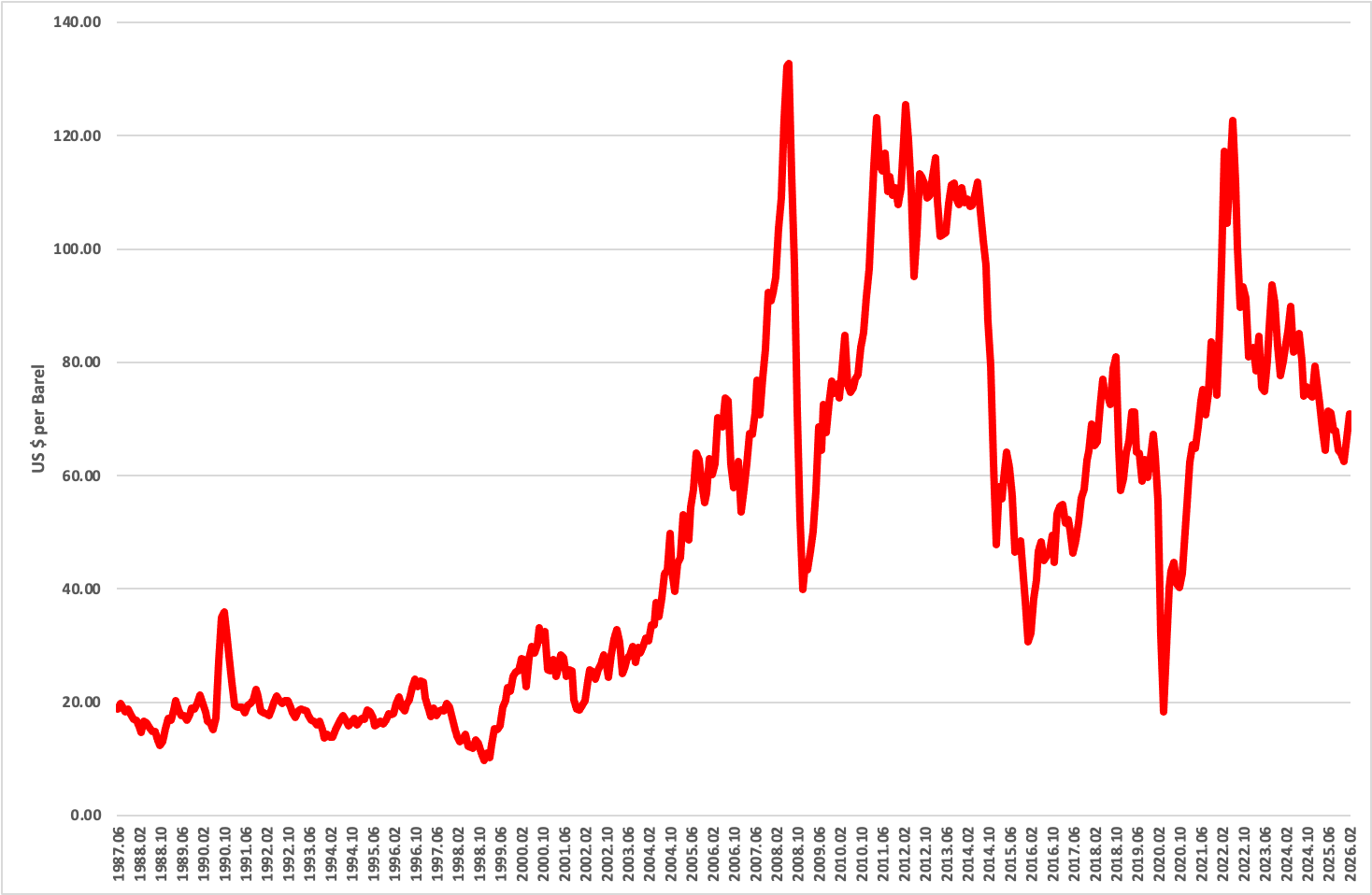
From the late 1980s through most of the 1990s, oil prices remained relatively stable. Following the collapse in prices in the mid-1980s, the global oil market entered a period of abundance. Brent crude generally traded between $15 and $25 per barrel. During this period, the world economy was expanding steadily, but oil supply remained ample and production capacity was sufficient to meet rising demand.
One notable interruption came in 1990–1991, when Iraq’s invasion of Kuwait and the subsequent Gulf War triggered a sharp but short-lived spike in oil prices. The disruption to supply and fears of broader instability in the Middle East caused markets to react quickly. Yet once the crisis subsided and production resumed, prices returned to their previous range.
Toward the end of the decade, another significant movement occurred in the opposite direction. The Asian financial crisis of 1997–1998 sharply reduced energy demand in some of the world’s fastest-growing economies. Oil prices fell dramatically, briefly approaching $10 per barrel in 1998—levels that seem almost unimaginable today.
The global oil market began to change profoundly in the early 2000s. Between 2002 and 2008 oil prices rose almost continuously, climbing from roughly $25 per barrel to nearly $140 in the summer of 2008. This dramatic increase reflected a major shift in the structure of the global economy.
The most important driver was the rapid rise of emerging economies, particularly China and India. Their industrialization, urbanization, and expanding transportation sectors generated an unprecedented surge in global energy demand. At the same time, oil production capacity was expanding more slowly, while geopolitical tensions—especially the Iraq War beginning in 2003—added uncertainty about future supply.
The peak in prices in 2008 coincided with the end of a long global economic expansion. When the global financial crisis erupted later that year, oil prices collapsed with remarkable speed. Between mid-2008 and early 2009 Brent crude fell from around $140 per barrel to below $40. The reason was straightforward: the global economy entered a deep recession, international trade contracted sharply, and demand for energy plummeted.
Following the crisis, oil markets stabilized for several years at relatively high levels. From 2010 to 2014 prices fluctuated mostly between $100 and $120 per barrel. The global economy had recovered, and geopolitical instability in parts of the Middle East—particularly in the wake of the Arab Spring in 2011—helped sustain high price levels by reinforcing concerns about potential supply disruptions.
Yet another major turning point arrived in 2014. The rapid expansion of shale oil production in the United States fundamentally altered the balance of the global oil market. Advances in hydraulic fracturing and horizontal drilling dramatically increased American oil output. This surge in supply created a global surplus. When the Organization of the Petroleum Exporting Countries (OPEC) initially chose not to cut production, prices collapsed. By 2016 Brent crude had fallen to roughly $30 per barrel.
A new shock came in 2020 with the outbreak of the COVID-19 pandemic. As governments imposed lockdowns and travel restrictions, global economic activity slowed dramatically. Demand for transportation fuels plunged. Oil prices dropped sharply, with Brent crude briefly falling close to $20 per barrel. The episode represented one of the most extraordinary disruptions in the history of energy markets.
The recovery that followed was equally striking. As economies reopened in 2021 and global demand rebounded, oil prices rose rapidly. In 2022, Russia’s invasion of Ukraine introduced a new geopolitical shock. Western sanctions on Russian energy exports and disruptions to global energy flows pushed oil prices once again above $120 per barrel for a period.
In recent years, however, prices have moderated somewhat. Brent crude has generally fluctuated between $60 and $90 per barrel, reflecting a new balance between global demand, the production strategies of major exporters, and gradual changes in the global energy system.
The long-term evolution of oil prices highlights the interaction of three fundamental forces. First, global economic growth plays a central role. When the world economy expands rapidly, demand for energy rises and oil prices tend to increase. Conversely, recessions or economic crises often lead to sharp price declines.
Second, geopolitical developments frequently influence oil markets. Conflicts, sanctions, and political instability in major producing regions—especially the Middle East—can quickly generate uncertainty about supply and drive prices upward.
Third, technological innovation has become increasingly important. The shale revolution in the United States demonstrated how technological advances can dramatically increase supply and reshape global energy markets.
The macroeconomic consequences of oil price fluctuations are substantial. Higher oil prices tend to push up inflation and place pressure on energy-importing economies. At the same time, they generate large revenues for oil-exporting countries. Lower oil prices have the opposite effect: they provide relief for energy-consuming economies but can create fiscal and economic challenges for major exporters.
Looking ahead, the gradual transition toward cleaner energy sources may eventually reduce the central role of oil in the global economy. Yet the history depicted in the chart suggests that oil will remain a key strategic commodity for many years to come. Its price movements continue to reflect the shifting balance of economic power, technological innovation, and geopolitical tensions across the world.
 Prof George Alogoskoufis