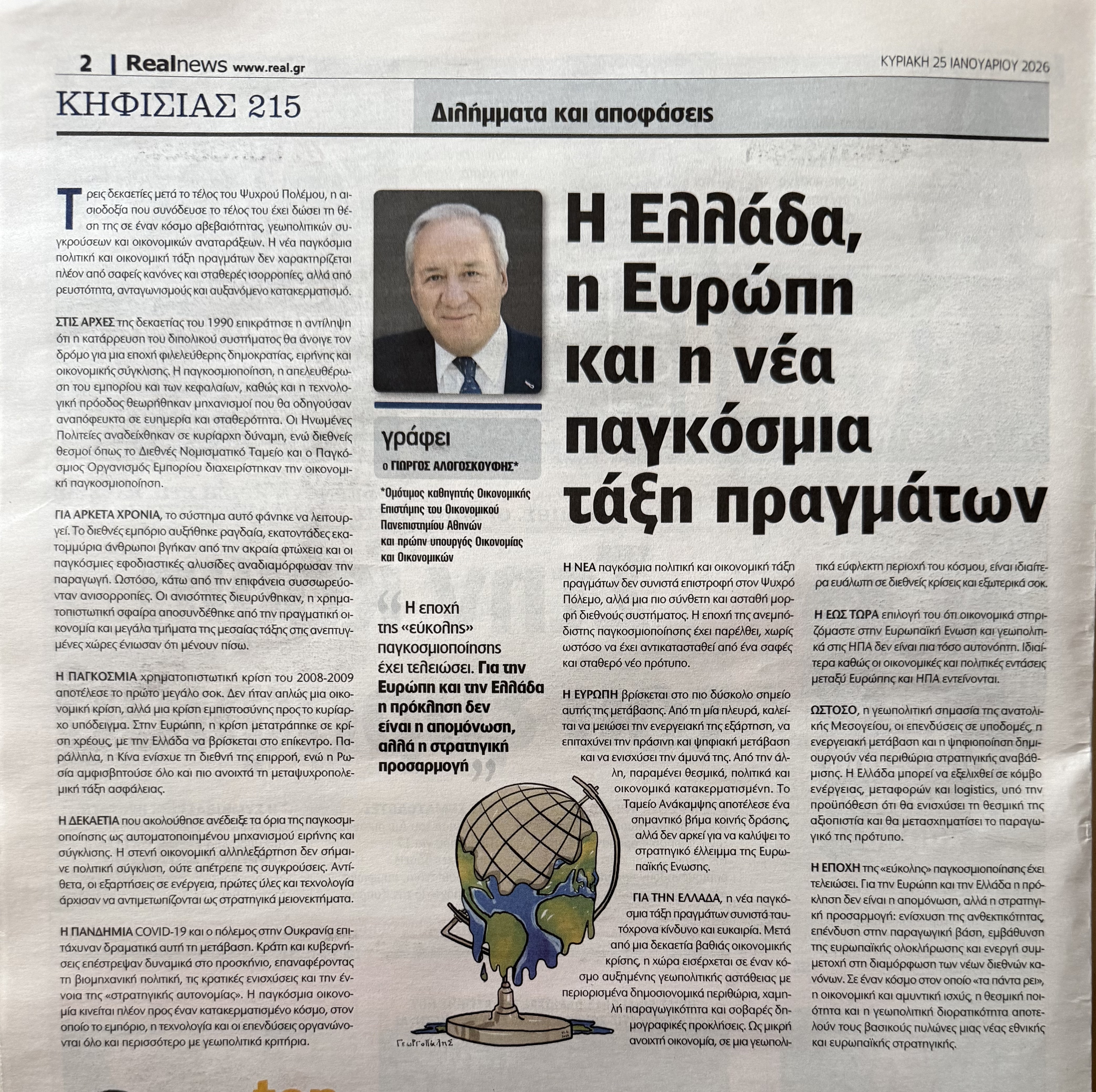
George Alogoskoufis
A shortened version of this article was published in Greek in the newspaper Real News, on January 25, 2026
_____________________________________________________________
Three decades after the end of the Cold War, the optimism that accompanied its conclusion has given way to a world marked by uncertainty, geopolitical conflict, and economic turbulence. The new global political and economic order is no longer defined by clear rules and stable equilibria, but by fluidity, competition, and increasing fragmentation.
In the early 1990s, the prevailing view was that the collapse of the bipolar system would usher in an era of liberal democracy, peace, and economic convergence. Globalization, the liberalization of trade and capital flows, and technological progress were seen as mechanisms that would inevitably lead to prosperity and stability. The United States emerged as the dominant power, while international institutions such as the International Monetary Fund and the World Trade Organization managed the process of economic globalization.
For several years, this system appeared to function effectively. International trade expanded rapidly, hundreds of millions of people were lifted out of extreme poverty, and global supply chains reshaped world production. Beneath the surface, however, imbalances were accumulating. Inequality widened, the financial sphere became detached from the real economy, and large segments of the middle class in advanced economies felt increasingly left behind.
The global financial crisis of 2008–09 was the first major shock. It was not merely an economic crisis, but a crisis of confidence in the dominant economic model. In Europe, it evolved into a sovereign debt crisis, with Greece at its epicenter. At the same time, China was strengthening its international influence, while Russia increasingly challenged the security order that had emerged after the end of the Cold War.
The decade that followed revealed the limits of globalization as an automatic mechanism of peace and convergence. Close economic interdependence did not imply political convergence, nor did it prevent conflict. On the contrary, dependencies in energy, raw materials, and technology began to be perceived as strategic vulnerabilities.
The COVID-19 pandemic and the war in the Ukraine dramatically accelerated this transition. States and governments returned forcefully to the forefront, reviving industrial policy, state aid, and the concept of “strategic autonomy.” The global economy is now moving toward a fragmented world, in which trade, technology, and investment are increasingly shaped by geopolitical criteria.
The New Role of the United States
More than thirty years after the end of the Cold War, the United States remains the central pole of the international system, but no longer under the same conditions or with the same self-confidence. The era of undisputed American primacy has passed, without being replaced by a new, stable leading power. Instead, a more complex global order is emerging, in which the United States remains the strongest actor but is compelled to operate in an environment of heightened competition, constraints, and uncertainty.
After 1991, American strategy was based on the assumption that military superiority, economic globalization, and the spread of liberal institutions would consolidate an international order favorable to U.S. interests. The United States assumed the role of “guarantor” of international security and the open global economy through institutions such as the IMF, the World Bank, the WTO, and NATO. This strategy produced stability in many regions but was also accompanied by excessive self-confidence.
Military interventions in the Middle East, particularly after 2001, exposed the limits of American power. Despite their unquestioned military superiority, the United States struggled to translate battlefield victories into sustainable political solutions. At the same time, the 2008 financial crisis undermined the credibility of the American economic model and cast doubt on Washington’s role as a “pillar of stability” in the global economy.
This crisis coincided with the rapid rise of China, which evolved from a regional power into a systemic competitor of the United States. Unlike the 1990s, when China was viewed as a country that could be integrated into the liberal international order, it is now perceived in Washington as a strategic rival. This confrontation extends beyond trade to technology, energy, infrastructure, and even the rules of global governance.
Within this context, the role of the United States is being transformed. American strategy is gradually abandoning the idea of universal globalization and adopting a more selective approach based on geoeconomics and alliances among “like-minded” states. Restrictions on exports of advanced technologies, the return of industrial policy, and support for domestic production mark a clear break with the past.
The COVID-19 pandemic and the war in Ukraine accelerated this shift. The United States returned forcefully to the forefront of European security, strengthening NATO and assuming a leading role in supporting Ukraine. At the same time, it employed economic instruments—sanctions, technology controls, financial restrictions—as core tools of power. Military strength remains crucial, but it is no longer sufficient on its own.
Nevertheless, American power is not unlimited. Domestic political divisions, high public debt, and social polarization constrain strategic consistency. Moreover, the fatigue of the American public with prolonged international commitments makes it more difficult to assume the role of “global policeman.” The United States must balance the need for leadership with pressures toward inward-looking policies.
In the new global order, the role of the United States is no longer to impose rules unilaterally, but to shape alliances and frameworks of cooperation that serve its strategic interests. Europe remains a critical partner, though not always an easy one. Disagreements over energy, trade, and industrial policy reveal that the West is less unified than in the past.
For smaller countries such as Greece, American strategy has direct implications. The strengthening of U.S. geopolitical presence in the Eastern Mediterranean, the emphasis on energy security, and the upgrading of military cooperation create new balances. At the same time, however, intensifying rivalry among major powers increases uncertainty and narrows room for maneuver.
The crucial question is not whether the United States remains powerful—it does—but how it exercises its power. In the new global order, American leadership is less taken for granted and more subject to negotiation. Its success will depend on its ability to combine power and cooperation, strategic determination and institutional legitimacy.
The world is not returning to the Cold War, but entering an era of prolonged competition without a clear final equilibrium. In this era, the United States is neither omnipotent nor marginalized. It remains the central—but not the sole—shaper of the new global order, and how it chooses to exercise this role will largely determine the shape of the world in the decades ahead.
China as the Central Systemic Competitor of the United States
For three decades after the end of the Cold War, China was the greatest beneficiary of globalization. Its integration into the global economic system, the attraction of foreign investment, and the large-scale transfer of technology transformed it into the world’s factory and a key engine of global growth. Today, however, China is no longer simply an emerging economy. It is a systemic competitor of the West and a central actor in shaping the new global order.
Chinese strategy has been based on a distinctive combination of state capitalism, controlled openness, and strict political control. Contrary to the expectations of the 1990s, economic integration did not lead to political liberalization. On the contrary, the Communist Party strengthened its role, using economic success as a source of legitimacy.
In the new international environment, China seeks to move from export dependence to a model of technological and industrial self-sufficiency. Its emphasis on artificial intelligence, 5G networks, renewable energy, and rare earths reflects the belief that power in the twenty-first century is not only military, but primarily technological.
At the same time, China promotes an alternative vision of international order, less rule-based and more centered on bilateral power relations. The Belt and Road Initiative is not merely an economic project, but a geopolitical tool for expanding influence. Through investments in infrastructure, ports, and energy, Beijing is building networks of dependency across Asia, Africa, and Europe.
Nevertheless, the Chinese model faces serious challenges. Slowing growth, a crisis in the real estate sector, population aging, and increasing restrictions imposed by the United States and its allies limit its room for maneuver. China must manage the transition from quantitative to qualitative growth in a far more hostile international environment.
In the new global order, China does not necessarily seek to replace the United States as hegemon. It does, however, seek to make the world safe for its own political and economic model. That alone is sufficient to transform the international system.
Europe: An Economic Giant with Strategic Deficits
Europe entered the post–Cold War era as a strategic satellite of the United States and as the quintessential space of peace, institutional integration, and economic prosperity. Today, however, the European Union faces a fundamental question: can it remain a global power in a world of hard competition, or will it be reduced to the role of a normative observer?
European success was built on economic integration, the single market, and the common currency. Yet the new global order demands more than rules and procedures. It requires strategic power, technological leadership, and geopolitical will. In these areas, Europe displays long-standing weaknesses.
The energy crisis and the war in Ukraine exposed the cost of European strategic naïveté. Dependence on cheap Russian energy and American security proved unsustainable. Despite important initiatives of collective action—such as the Recovery Fund—Europe continues to operate with slowness and internal contradictions.
Technological lag behind the United States and China is perhaps the greatest challenge. Europe regulates, but does not innovate at the same pace. At the same time, demographic trends and low productivity constrain its dynamism.
Nevertheless, Europe possesses significant strengths: institutional stability, human capital, high living standards, and strong regulatory power. The critical question is whether it can convert these assets into strategic power, or whether it will remain a “regulatory superpower” in a world where rules are increasingly contested.
Strengthening Europe as a geopolitical actor has become a matter of survival rather than choice.
Russia: A Factor of Destabilization
Russia entered the post–Cold War era as the great loser. The loss of imperial status, the economic collapse of the 1990s, and NATO enlargement fostered a sense of historical humiliation. From the early 2000s onward, Russian strategy systematically aimed at revising this order.
Unlike China, Russia lacks the economic and technological depth to compete with the West on a global scale. It does, however, possess military power, energy resources, and geopolitical determination. These tools have been used to restore violence and coercion to the center of international relations.
The war in the Ukraine is not merely a regional conflict. It is a direct challenge to the principles of the post–Cold War European order: sovereignty, territorial integrity, and peaceful coexistence. Russia seeks to impose spheres of influence and prevent further Western expansion.
Yet Russian strategy carries high costs. Sanctions, technological isolation, and growing dependence on China constrain its long-term prospects. Russia is gradually shifting from an autonomous pole of power to a junior partner in a Eurasian axis.
In the new global order, Russia does not offer an alternative vision of international organization. It offers destabilization. And that alone is sufficient to profoundly affect balances, particularly in Europe.
The Rest of the World and the Emerging Economies
In discussions of the new global order, attention often focuses on the major powers: the United States, China, Europe, and Russia. Yet the most critical—and least predictable—variable lies elsewhere: in the so-called “rest of the world.” This heterogeneous group of countries in Asia, Africa, Latin America, and the Middle East does not wish to be drawn into a new bipolar structure and seeks greater strategic autonomy.
Unlike during the Cold War, today’s “rest of the world” is not united by a single ideology or coherent political bloc. What unites it is pragmatism. Most countries seek to maximize benefits from great-power competition while avoiding commitments that would limit flexibility. This stance was clearly evident in responses to the war in Ukraine, where much of the world opted for neutrality or carefully balanced positions.
India exemplifies this new logic. As the world’s most populous country and a rapidly growing economy, India aims to emerge as an autonomous global player. It cooperates closely with the United States in the Indo-Pacific while maintaining strategic ties with Russia and commercial relations with China. It does not choose camps; it chooses interests.
Brazil follows a similar path, seeking to reassert itself as a leading power in Latin America. It pursues a multidimensional foreign policy, strengthening ties with China without severing links with the West. For many countries in the region, the new global order is not a threat but an opportunity to negotiate better terms for trade, investment, and finance.
In the Middle East, the picture is even more complex. Countries such as Saudi Arabia no longer act as passive allies of major powers, but as autonomous geopolitical actors. Energy transition, technological investment, and economic diversification enable them to negotiate simultaneously with the United States, China, and Russia. Control over critical resources, such as oil, grants them disproportionate influence, particularly during periods of global instability.
A special category consists of “middle powers” with strong regional presence, such as Turkey. Exploiting its geographic position, Turkey operates between West and Eurasia, seeking the role of mediator as well as autonomous actor. Its strategy is not based on institutional consistency, but on constant renegotiation of balances.
In this environment, the concept of the “rest of the world” takes on new meaning. These are not merely lower-income or developing economies, but states demanding a greater voice in shaping international rules. Groupings such as the BRICS reflect this ambition, even if they lack cohesion and a shared strategic vision.
The growing importance of the “rest of the world” does not necessarily imply greater stability. Many of these countries face serious internal challenges: demographic pressures, inequality, political instability, and climate vulnerability. The new global order intensifies risks, as great-power competition is often played out in peripheral regions.
For Europe and countries such as Greece, these developments are of direct relevance. The Mediterranean, the Middle East, and Africa are not distant worlds, but immediate geopolitical environments. Migration flows, energy networks, and trade corridors tie Greek and European security to the stability of the “rest of the world.”
The defining feature of the new era is that the “rest of the world” no longer acts as a passive recipient of decisions. It acts as an aspiring active co-shaper of emerging balances. These countries do not seek to overturn the international system, but to shift it toward a more polycentric form.
In a world where no power can impose rules unilaterally, the stance of the “rest of the world” will largely determine the shape of the new global order. And this stance can be summarized in one word: choice. Not ideological, but strategic. Not permanent, but revisable. This pragmatism makes the “rest of the world” the most flexible—and potentially the most decisive—actor of the twenty-first century.
Challenges for Greece
For Greece, the new global order presents both risks and opportunities. After a decade of deep economic crisis, the country enters a world of heightened geopolitical instability with limited fiscal space, low productivity, and serious demographic challenges. As a small open economy, Greece is particularly vulnerable to international crises and external shocks.
Greece’s longstanding choice to rely economically on the European Union and geopolitically on the United States is no longer as self-evident as it once was, especially as economic and political tensions between Europe and the United States intensify.
At the same time, the geopolitical significance of the Eastern Mediterranean, investments in infrastructure, the energy transition, and digitalization create new opportunities for strategic upgrading. Greece can evolve into a hub for energy, transport, and logistics, provided it strengthens institutional credibility and transforms its productive model.
Epilogue
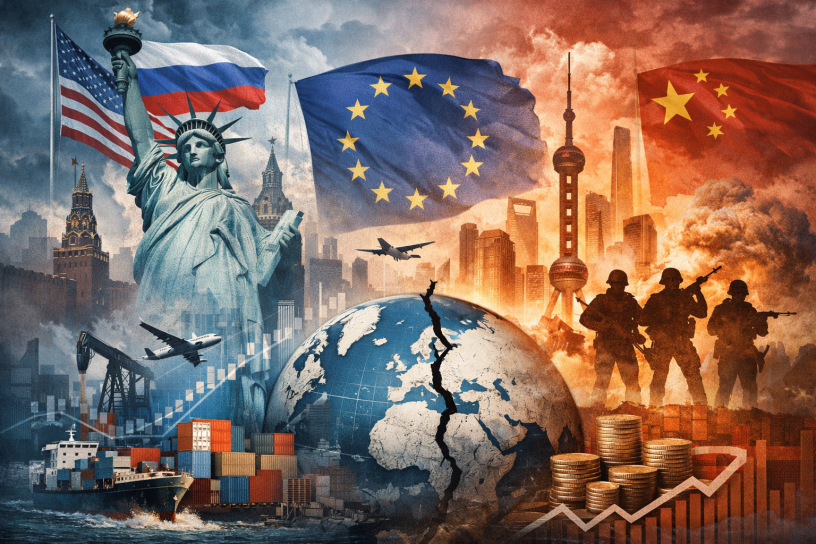
The overall picture is clear: the new global order is not structured around a single leading power, nor around a coherent system of rules. The United States remains the strongest actor, but not the undisputed regulator. China claims a systemic role without offering a universally attractive model. Europe possesses economic weight but lacks strategic cohesion. Russia acts primarily as a revisionist and destabilizing force. And the so-called “rest of the world” increasingly chooses pragmatism and flexibility.
The common thread linking all these actors is the transition from an era of rules to an era of balances. Globalization does not disappear, but changes form. Economic interdependence remains, yet is no longer seen as a guarantee of peace or stability. Geopolitics returns forcefully—not only through military power, but also through energy, technology, supply chains, and financial instruments.
For Europe, and particularly for countries such as Greece, the conclusion is twofold. On the one hand, the world is becoming more dangerous and less predictable. On the other, the era of automatic solutions and self-evident external “anchors” has ended. The challenge is not retrenchment, but adaptation: greater strategic thinking, stronger resilience, and an active role in shaping new international balances.
The remainder of the twenty-first century does not appear, on current evidence, to evolve into a stable, but an era of continuous adjustment. In this environment, power is not only a matter of size; it is also a matter of choices. And these choices, more than the intentions of the great powers, will determine the shape of the world now taking form.
 Prof George Alogoskoufis