George Alogoskoufis
This article is adapted from an article in Greek, in the newspaper To Vima, December 28, 2025
________________________________________
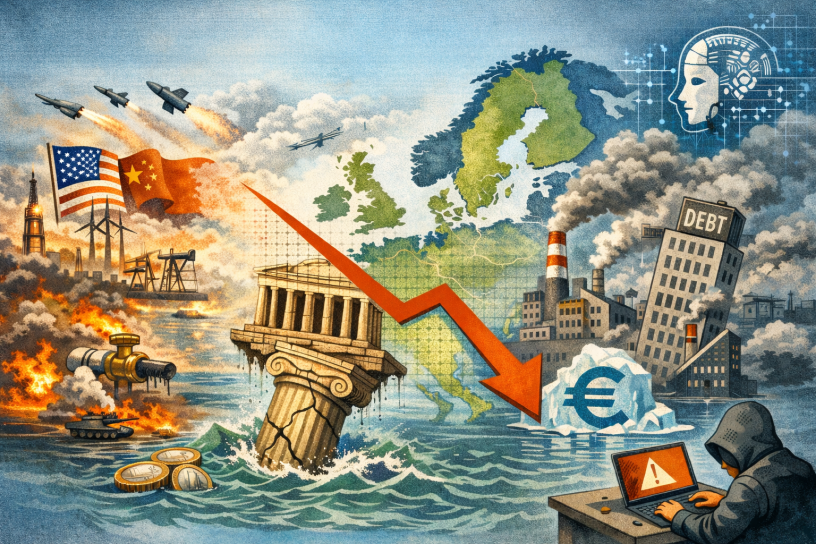
The global economy has entered a period of flux and sustained uncertainty. Risks no longer arise sequentially but simultaneously, from multiple directions: geopolitics, energy markets, inflation, debt, and technological disruption. Stability has become the exception rather than the rule. In short, everything flows.
Global growth continues, but at a noticeably slower pace. According to the IMF, average world growth is expected to fall from 3.6% in 2021–25 to 2.6% in 2026–30. Europe’s slowdown is sharper still, from 2.7% to 1.5%. Greece, despite strong recent performance, faces an even steeper deceleration—from 4.2% to 1.7%. The world is not heading for recession, but it is settling into a lower-growth equilibrium.
Geopolitics is the most obvious source of unease. America’s rivalry with China has broadened well beyond tariffs. Technology, semiconductors, rare earths and supply chains are now strategic assets. Economic “decoupling”, once dismissed as unrealistic, is increasingly policy. Other countries, caught in between, are being forced to rethink trade, investment and industrial strategies.
Regional conflicts add to the strain. The war in Ukraine and chronic instability in the Middle East continue to inject volatility into food, energy and transport markets. The risk of escalation remains, and with it the possibility of further disruptions to global commerce.
Energy is the second fault line. Prices for gas and oil remain volatile, while uncertainty over the speed and cost of the green transition clouds investment decisions. Climate change compounds the problem. Extreme weather is no longer a tail risk but a recurring shock, affecting agriculture, infrastructure and supply chains.
Europe is particularly exposed. Although it has sharply reduced dependence on Russian gas, energy remains far more expensive than in America or Asia. That undermines the competitiveness of energy-intensive industries such as chemicals, metals and manufacturing. Without reliable and affordable power, Europe risks a slow erosion of its industrial base.
Inflation, meanwhile, has eased but not vanished. Energy costs, supply bottlenecks and wage pressures persist. Central banks, wary of declaring victory too soon, are keeping interest rates higher for longer. This has consequences. Cheap money masked many vulnerabilities; tighter financial conditions are now revealing them.
Global debt is one such vulnerability. After a decade of ultra-low rates, governments and firms accumulated liabilities that are now harder to service. The risk of fresh debt crises is rising, especially in emerging markets—but not only there. Several large European economies remain heavily indebted and exposed to shifts in market sentiment.
China represents a separate, systemic concern. A bloated property sector, high corporate leverage and strained local government finances form an uncomfortable triangle. A disorderly adjustment would not remain a domestic affair; it would reverberate through global trade and financial markets.
Property markets elsewhere are also wobbling. Housing prices in many countries have plateaued or fallen. Commercial real estate faces a structural challenge from remote work and declining demand for office space. Banks and investment funds with heavy exposure are watching nervously.
Technology offers hope—and risk. Artificial intelligence promises productivity gains, but it has also fuelled exuberant asset valuations. Some fear that expectations have run ahead of reality. At the same time, automation is reshaping labour markets, unsettling workers and complicating public finances that rely on payroll-based contributions.
Cyber threats add another layer of fragility. Attacks on critical infrastructure are increasing, with potentially serious economic consequences.
Europe stands out as especially vulnerable to this toxic mix. Productivity growth is weak, populations are ageing and the continent struggles to attract large-scale technology investment. Fiscal rules are back, narrowing room for manoeuvre in highly indebted countries such as Italy and France. Sovereign spreads, long dormant, could again command attention.
Politics does not help. The rise of populist and eurosceptic parties complicates reform and weakens coordination on issues ranging from climate policy to migration and fiscal integration.
Greece, for all its recent success, is not immune. Growth has outpaced the EU average, but longstanding weaknesses remain: high external debt, political polarisation, a narrow productive base, limited exposure to high-technology exports, demographic decline and heavy reliance on energy, tourism and transport. External shocks still matter disproportionately.
Yet prolonged uncertainty also creates opportunity. Countries that invest wisely, maintain fiscal credibility, raise productivity and act decisively on energy, education and technology can emerge stronger. Greece, having already travelled far, could use this period not merely to withstand turbulence but to upgrade its economic model.
The global economy is entering an era in which energy shocks, geopolitical rivalry, financial stress and technological change interact rather than occur in isolation. Navigating it will require realism, coordination and adaptability. In a world where little is guaranteed, resilience—not complacency—will determine who prospers and who falls behind.
 Prof George Alogoskoufis