George Alogoskoufis
A version of this article in Greek was published online in the newspaper To Vima, on September 11, 2025, and a shorter version in the newspaper Ta Nea, on October 11, 2025, both in Greek.
The watercolor sketch depicts three prime ministers to Greece who prioritized the development of the Greek economy, Charilaos Trikoupis, Eleftherios Venizelos and Constantine Karamanlis
_______________________________________________
The slow recovery of the Greek economy after the great depression of the 2010s has reignited the debate on how faster growth can be achieved without endangering the hard-won fiscal, monetary, and external balance.
Recent interventions by the prime minister, party leaders, and former prime ministers provide different answers on the way forward and different interpretations of the country’s economic history. But what is the reality?
The economic history of Greece shows a combination of impressive periods of growth and major crises, often linked to external borrowing.
As I have documented in my book Historical Cycles of the Greek Economy (Gutenberg, 2021, in Greek), since the establishment of the modern Greek state in the early 19th century, the country’s development path has been shaped by domestic social and political dynamics, external shocks, the evolution of political institutions and policy rules, and the effort to integrate into the global economy. With the exception of the first two decades after the end of the civil war in 1949, attempts at rapid economic growth were historically rather ineffective, as they relied on external borrowing and often ended in painful sovereign debt crises or defaults.
After independence, the economy remained agrarian, with agriculture, shipping, and remittances from the Greek diaspora as its main pillars. Industrialization was limited, while sovereign debt defaults (1843, 1893, 1932) highlighted fiscal and productive weaknesses. The Trikoupis era brought infrastructure and institutional modernization, but was based on foreign borrowing. In the interwar years, refugee resettlement and investments of Venizelos’ last government boosted the economy, but the Great Depression and dependence on foreign capital led to another crisis.
The 1940s were catastrophic due to war, occupation, and civil war. By contrast, between 1953 and 1973, Greece experienced unprecedented growth rates of 7% annually, with industrialization, investments, and the rise of tourism and shipping. This period, which was not based on external borrowing but on domestic savings, led to significant convergence with Western Europe. Decisive elements of the economic policy that produced this “economic miracle” were the Marshall Plan (1948–1952), the governments of 1950–1954, and the eight-year administration of Konstantinos Karamanlis (1955–1963), which emphasized development-oriented investment and fiscal and monetary stability, setting the tone for subsequent governments. Despite political instability after 1963, the economy continued to grow. However, the imposition of the seven-year dictatorship and the excesses it gradually adopted in economic policy, in a changing international environment, eventually led to stagflation.
As I documented in my more recent book, Before and After the Political Transition: Institutions, Politics and the Economy in Greece (Gutenberg, 2024, in Greek), after 1974 the focus shifted from growth to redistribution of income and wealth. Accession to the EEC/EU and EU funds helped, but growth remained weak, with high deficits and debt. The reforms of the 1990s, despite their shortcomings, allowed entry into the EMU. The euro initially brought stability and growth, but also masked deep structural weaknesses: low productivity and international competitiveness, and high fiscal and external deficits.
The global financial crisis of 2008 and rising political instability led to the debt crisis of 2010 and the deepest peacetime depression: GDP contracted by more than 25%, unemployment exceeded 27%. The memoranda linked to the EU bailouts imposed austerity but also introduced some beneficial reforms. After 2016 there was a recovery, interrupted by the pandemic, while European support through the Recovery Fund offered new opportunities. Nevertheless, growth remains sluggish, though slightly above the EU average.
Today, the Greek economy and economic policy face seven interlinked challenges that will shape the country’s future growth path:
- Demographics: Population aging and low birth rates reduce the labor force and squeeze both growth prospects and the pension system. Policies are needed to increase labor force participation of youth and women, while a targeted migration policy, and measures to support birth rates are also needed.
- Investment – Productivity – Innovation: This triptych encapsulates Greece’s main development weaknesses. The low investment rate in fixed capital must be raised, alongside higher savings to avoid worsening the current account balance. At the same time, businesses’ limited adoption of new technologies and low R&D spending must be addressed.
- Green Transition: Major restructuring and new investments are required. The shift from fossil fuels to renewable energy is inevitable and critical for future growth, but demands significant long-term investment and deep productive restructuring.
- Digital Transformation: Despite recent improvements, digital transformation is not progressing fast enough. Modernization of public administration and businesses is essential for competitiveness and growth prospects.
- Fiscal Sustainability: Despite recent improvements, the high public debt-to-GDP ratio remains a long-term burden and source of risk.
- External Imbalances: The current account—and especially the trade balance—remains heavily in deficit. This shows the urgent need to improve international competitiveness and restructure production toward tradable and export-oriented goods and services.
- Geopolitical Risks: Tensions in the Eastern Mediterranean and new international uncertainties require vigilance in foreign policy and stronger use of Greece’s EU membership.
The course of the Greek economy is a history of contrasts: spectacular progress but also long periods of stagnation or deep crises. The postwar miracle shows the country’s potential when stability and investment based on domestic resources prevail. The future depends on overcoming macroeconomic imbalances and structural weaknesses, utilizing European resources, achieving the green and digital transition, and strengthening human capital. There are no magical solutions nor political miracle makers. The only solution is the adoption of a long-term program of socially fair development-oriented reforms, supported by political consensus by all major parties and implemented consistently, at least regarding its main pillars, regardless of changes in government.
Link to the article in Greek in the newspaper To Vima
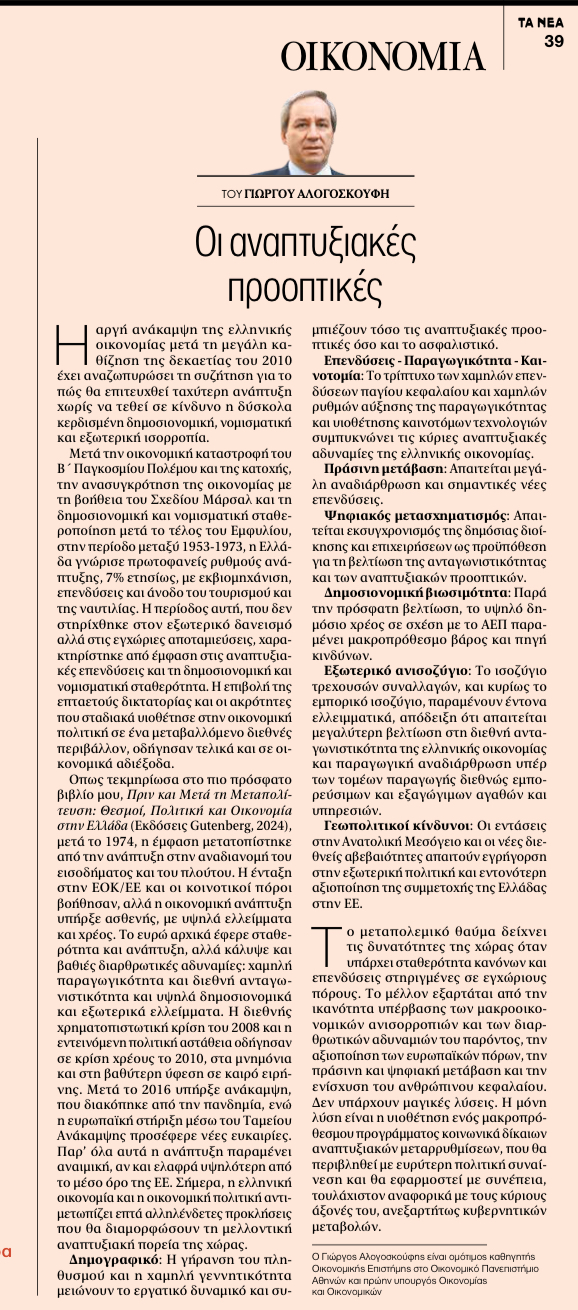
Link to the shorter article in Greek in the newspaper Ta Nea
For research papers in English supporting the analysis of this article see:
 Prof George Alogoskoufis