
George Alogoskoufis
____________________________________________
As of April 2025, the U.S.–China trade war has escalated significantly, with both nations imposing steep tariffs and implementing retaliatory measures that are impacting global markets and supply chains.
President Donald Trump has raised tariffs on Chinese imports to an effective rate of 145%, citing concerns over trade imbalances and national security. China has responded with 125% tariffs on U.S. goods, targeting key sectors such as agriculture and manufacturing. The US imposed new export bans on critical technologies, including AI chips from companies like Nvidia, to curb China’s technological advancements. Beijing has halted exports of critical rare earth elements essential for U.S. tech, defense, and EV industries, and has banned imports of Boeing aircraft, affecting the American aerospace sector.
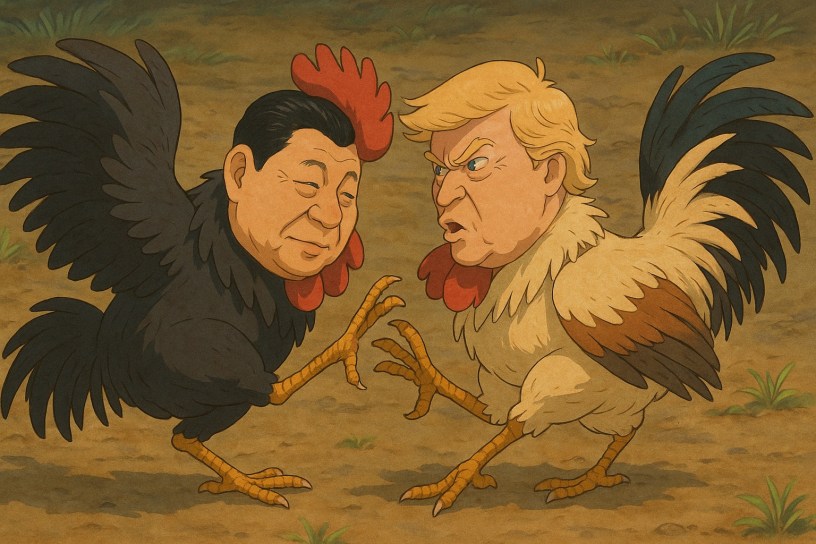
The U.S.–China trade war can be modeled as a symmetric Game of Chicken, a classic parable in game theory, that actually mirrors the key dynamics pretty well. Modelling this conflict as such a game can help us predict what is the likely final outcome.
Consider a game of chicken in which two symmetric players, the USA and China, can decide to either retreat (chicken-out) or escalate (stay tough). A suggestive payoff matrix for the various outcomes is included in the attached table.
Payoff Matrix of USA-China Trade Game
| USA / China | Retreat | Escalate |
| Retreat | (Small Losses, Small Losses) Mutual compromise | (Medium Losses, Medium Gains) China wins |
| Escalate | (Medium Gains, Medium Losses) USA Wins | (Large Losses, Large Losses) Trade war escalates, both suffer |
If both retreat (chicken out), as in the top left corner, they both sustain small losses. If both escalate they both sustain large losses. If one retreats and the other escalates, the one that retreats (chicken) sustains medium losses and the one that escalates (tough) sustains medium gains.
Because the loss of retreating is small compared to the trade war that occurs if nobody retreats, the reasonable strategy for each player would seem to be to retreat before a trade war is likely. Yet, knowing this, if the USA believes China to be reasonable, it may well decide to escalate, in the belief that China will decide to retreat, leaving the USA the winner. The same also applies to China. In such a situation, each player, in attempting to secure their best outcome, escalates, bringing about the worst outcome. This is what appears to have happened, as both the US and China have chosen to escalate, in the mistaken belief that the other would retreat.
Clearly, the escalate-escalate outcome is not a Nash equilibrium, as both players have an incentive to retreat from their strategy and either unilaterally de-escalate, or cooperate to achieve a mutual de-escalation. A Nash equilibrium is a pair of strategies for which neither player gains by changing their own strategy while the other stays the same. In this particular example, there are two pure strategy Nash equilibria, the two situations on the bottom left and the top right boxes in the table, wherein one player retreats while the other escalates. There is a third equilibrium, a mixed strategy equilibrium, where both individuals randomly chose between retreating or escalating. Finally, the players may choose to cooperate and mutually retreat and achieve the outcome in the top left hand corner. This outcome is also not a Nash equilibrium in the absence of cooperation, but it is face saving for both and can be sustained through cooperation.
Let us hope that the mutual de-escalation happens sooner rather than later.
 Prof George Alogoskoufis